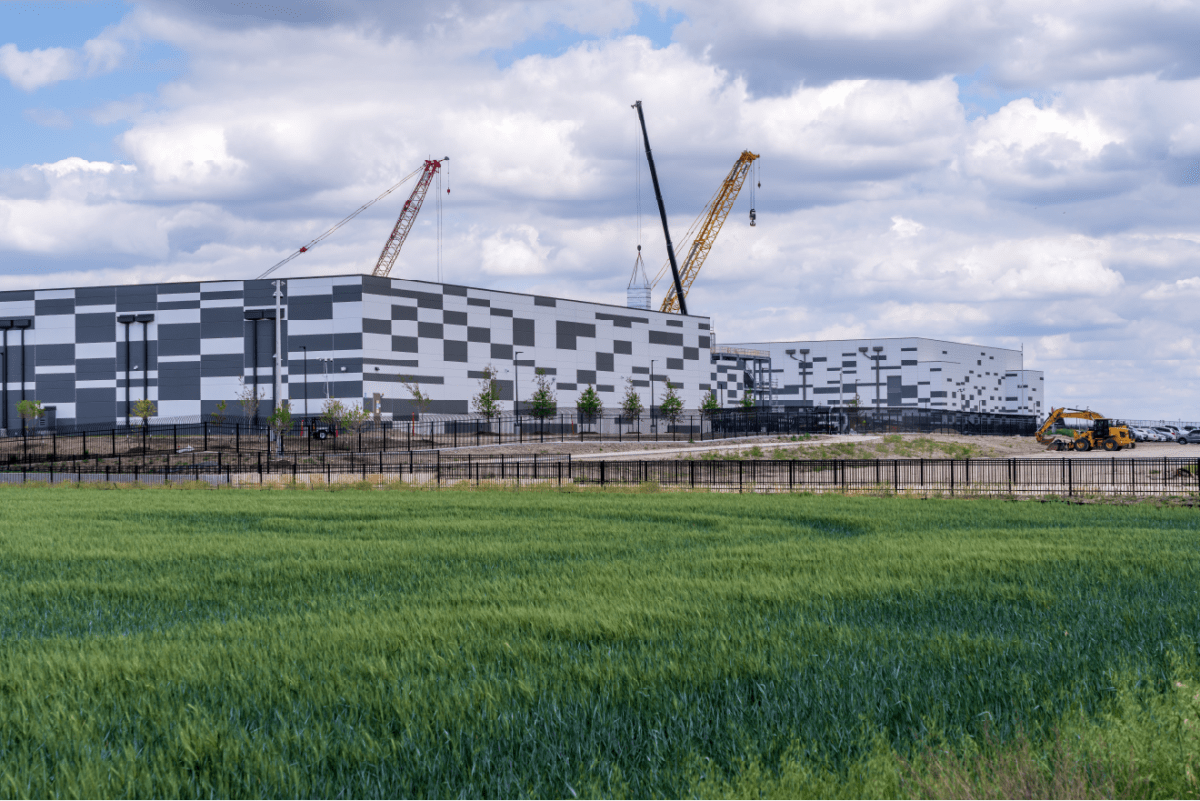
Timing around America’s Semiquincentennial celebration has us feeling nostalgic about the innovation and can-do attitude that created our great country. We’ve always loved building things in the U.S. and this has benefited us all. In the last half century or so, however, we have gotten increasingly protective about where we are building. Not in My Backyard, or “NIMBY” gained prevalence in the 1970s and 1980s in response to hazardous waste sites, nuclear power plants and other objectionable facilities encroaching on residential areas. We’ve taken things up a notch recently and NIMBY has accelerated toward BANANA – Build Absolutely Nothing Anywhere Near Anyone – and opponents have turned their sights on the data center.
The Buildout
Data center capital expenditure in the United States is on pace to approach several hundred billion dollars in 2026, a figure that would have seemed implausible only a few years ago. Hyperscalers like Alphabet, Meta, Microsoft and Amazon continue to justify this spending as necessary infrastructure for the next phase of computing, and equity markets have largely rewarded that thesis.
The Backlash
The friction manifests primarily on consumers’ electricity bills. Communities near large data center clusters have reported meaningfully higher power costs, and both political parties have found rare common ground in demanding that technology companies bear those costs rather than passing them to residential ratepayers. There is also some contention about data center water consumption, but that issue has moved to the back burner (for now) as most data centers have moved to a self-contained and recyclable water model.
Several data center operators have acknowledged and even tried to meet these demands. Through the White House’s voluntary Ratepayer Protection Pledge, several hyperscalers have agreed to cover the infrastructure costs tied to their power needs rather than passing them to residential ratepayers. Additionally, facilities that generate electricity “behind the meter,” typically with on-site natural gas turbines, avoid both the multi-year grid interconnection queues that now stretch past five years in some regions and, proponents argue, any responsibility for raising rates on the surrounding grid. Estimates suggest roughly a quarter of incremental data center demand through 2030 could be met this way.
Skeptics counter that the arguments are incomplete. The Ratepayer Protection pledge is voluntary and has no independent audit mechanism. And, self-generation still carries real costs, including redundancy and backup capacity, that show up somewhere in the system, and behind-the-meter gas buildouts in states such as Virginia have drawn scrutiny for potentially routing around existing clean energy statutes.
The result of the ongoing debate is dozens of proposed projects worth over one hundred billion dollars have been delayed or canceled amid local opposition since the start of the year.
Regulation Looms
Washington has noticed and so have state capitals. New York offers a recent example. In June, the state legislature passed the Responsible Data Center Development Act, a one-year moratorium on new permits for data centers with peak demand of 20 megawatts or more. Governor Kathy Hochul had not signed that bill as of mid-July, but she moved anyway, issuing an executive order in July that pauses new hyperscale projects of 50 megawatts or more for up to a year. New York’s move mirrors Arizona’s recent three-year moratorium on data center sales tax breaks and adds momentum to a broader wave of state and local action.
Congress, separately, has introduced legislation aimed at requiring large power users to cover the cost of grid upgrades needed to support them. At the same time, federal energy officials argue that data centers will ultimately lower power costs by driving investment in generation capacity, a claim that grid operators and independent researchers have publicly disputed.
What Does it Mean for Investors?
For investors, the data center debate is not merely a policy curiosity. It sits atop the earnings thesis for several of the largest companies in the world. Should regulation shift meaningful cost burden onto companies, or should local opposition materially slow the pace of new capacity, the capital spending that underwrites current earnings growth expectations could face headwinds. Moreover, regulatory friction could cause a relinquishment of America’s current lead in the AI race.
Data centers currently power the market’s earnings engine and, increasingly, the public’s electricity bill. At the same time, regulatory risk ranks amongst the top risks for the AI buildout and the subsequent potential impacts on the debt and equity capital markets. We’ll continue to watch these issues closely.
Investing in securities involves the risk of loss. Past performance is not indicative of or a guarantee of future results. The securities identified and described do not represent all the securities purchased, sold, or recommended for clients’ accounts. The reader should not assume that an investment in the securities identified was or will be profitable. The opinions expressed herein are subject to change at any time without notice.